.png)

SAP (Systems, Applications, and Products in Data Processing) is the world's leading enterprise application software vendor, serving over 400,000 customers across more than 180 countries. Its core products include SAP S/4HANA for ERP, SAP SuccessFactors for HR, SAP Ariba for procurement, SAP Analytics Cloud for business intelligence, and SAP BTP for cloud development and integration. SAP has increasingly embedded AI across its portfolio through Joule, its generative AI copilot, and the AI capabilities available across its business applications and SAP Business Technology Platform.
SAP was founded in Mannheim, Germany in 1972 by a group of IBM colleagues: Dietmar Hopp, Hans-Werner Hector, Hasso Plattner, Klaus Tschira, and Claus Wellenreuther. Their goal was to create real-time business software for companies; they started with financial accounting and would eventually expand outward to other areas of business.
The software at the center of SAP’s first financial accounting solution was termed the R/1 system. Its adoption provided enough funds for the company to continue developing updated and newer features; by the end of the 1970s, the R/1 system was overhauled and released to the public as R/2. New to this iteration was a database and dialog control system.
SAP grew its market share during the 1980s; at one point, half of the top 100 German companies used SAP software in their organizations. Eventually, international offices were opened to sell products to other markets, and by 1990 subsidiaries were located in Austria, Denmark, Sweden, Italy, and the United States.
The 1990s saw more growth for the German company, from becoming listed on the New York Stock Exchange to introducing its third-generation enterprise computing software. R/3 provided more front-end accessibility for end users and ran on a new three-tier client/server architecture. During this decade, SAP also began integrating its products with e-commerce and web technologies in a partnership with Microsoft.
By 2004, SAP was the third-largest software vendor in the world, behind Microsoft and IBM. In order to stay on the cutting edge of ERP software, SAP employed a two-pronged strategy: the first was to release a new flagship application, SAP ERP Central Component (SAP ECC, but regularly shortened to SAP ERP—which will be used in this document going forward). The second was to look to the future by creating a revolutionary new way to do business. Co-founder Plattner led this team as they searched for the answer to the question, “How do I get business questions answered the moment they’re asked?”
In 2010, SAP had its answer, one that would be its biggest contribution to the computing industry: the in-memory database known as SAP HANA. In the eight years following its general availability release in 2011, more than 30,000 customers began utilizing SAP HANA.
SAP HANA would also serve as the foundation of a new flagship product. Launched in 2015 with a set of robust financials capabilities, SAP S/4HANA was announced as SAP’s replacement for SAP ERP. Additional lines of business (LoBs) have been added to SAP S/4HANA since 2015; there are currently nine LoBs.
In the 2010s, SAP also looked to expand its offerings by acquiring a number of existing products to fill gaps in market coverage or that could be used in tandem with existing SAP solutions to add more functionality to the SAP S/4HANA solution. Starting in 2010, SAP acquired numerous market-leading products, including hybris, Ariba, Concur, SuccessFactors, BusinessObjects, and Signavio.
In the 2020s, SAP significantly accelerated its AI strategy, embedding generative AI across its product portfolio through Joule (its AI copilot) and establishing SAP AI Foundation as the underlying infrastructure for building and deploying AI solutions. SAP also deepened its cloud-first direction, expanding SAP BTP and reinforcing its clean core strategy to help customers adopt innovation without accumulating technical debt.
SAP offers products for a wide range of industries and business processes, from leading oil and gas production firms to sports teams to product-and service-based companies. This means, in theory, that anybody doing business should be able to find something from SAP that can help them run their business better.
SAP offers licenses of individual solutions for companies who need help in just one functional area, provides full-suite platforms for companies that choose to operate all business with SAP software, and publishes new updates quarterly (for cloud-based systems) or annually (for on-premise systems) for customers.
SAP currently offers two major ERP suites: SAP ERP (ECC) and SAP S/4HANA.
SAP ERP is SAP’s legacy business suite. Building off the R/1, R/2, and R/3 solutions, it was this application that first integrated with the internet on a large scale. Customers using SAP ERP can deploy it on a variety of supported operating systems and database platforms.
With the release of SAP S/4HANA, SAP is preparing to sunset SAP ERP. Customers can expect maintenance and occasional updates of core applications through 2027 with some additional, extended maintenance planned through 2030.
As a complete platform, SAP ERP consists of transactional and analytical systems. Below provides a brief definition of each core area.
Sometimes there is confusion around the terms SAP and ERP and whether they mean the same thing. ERP is, generally, enterprise resource planning software that helps businesses perform their activities. SAP is one of many vendors of ERP software. SAP ERP is the option that SAP offers to customers.
While many organizations have already migrated to SAP S/4HANA, thousands of businesses around the world still run SAP ERP (ECC). Because enterprise software projects often span many years, both platforms remain important for SAP professionals. Understanding SAP ERP concepts provides valuable context for learning SAP S/4HANA and newer cloud solutions.
The SAP Enterprise Resource Planning application focuses on financial, human capital, operational, and corporate services. This includes both financial and managerial accounting, personnel information and career development processing, day-to-day business operations, and external activities such as travel management.
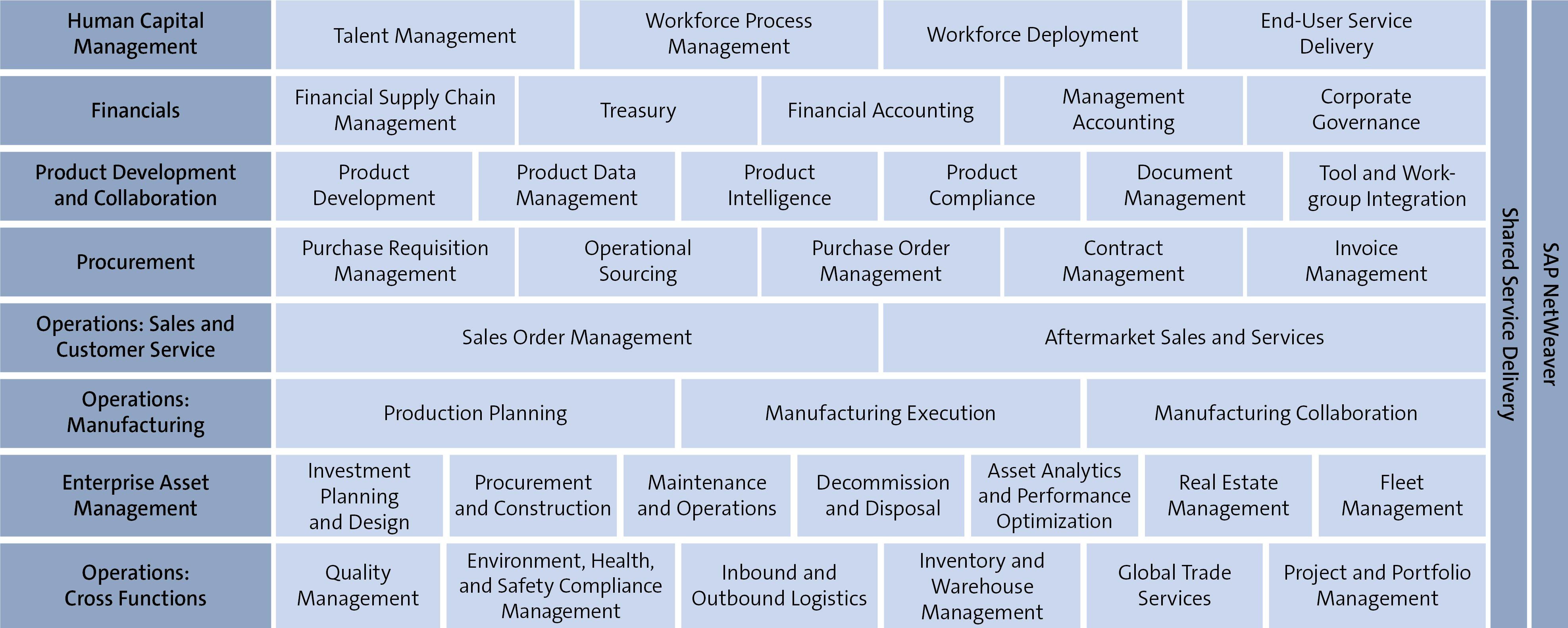
Note that SAP ERP in this case refers to an application and not the business suite known as SAP ERP Central Component (ECC, also SAP ERP). To avoid confusion, a good rule of thumb is to assume that when SAP ERP is being mentioned on its own (“we run SAP ERP and are moving to SAP S/4HANA”) that SAP ECC is being referred to, and when SAP ERP is followed by a specific system (“we run SAP ERP FI-CO in the organization”) that the SAP ERP application is being referred to.
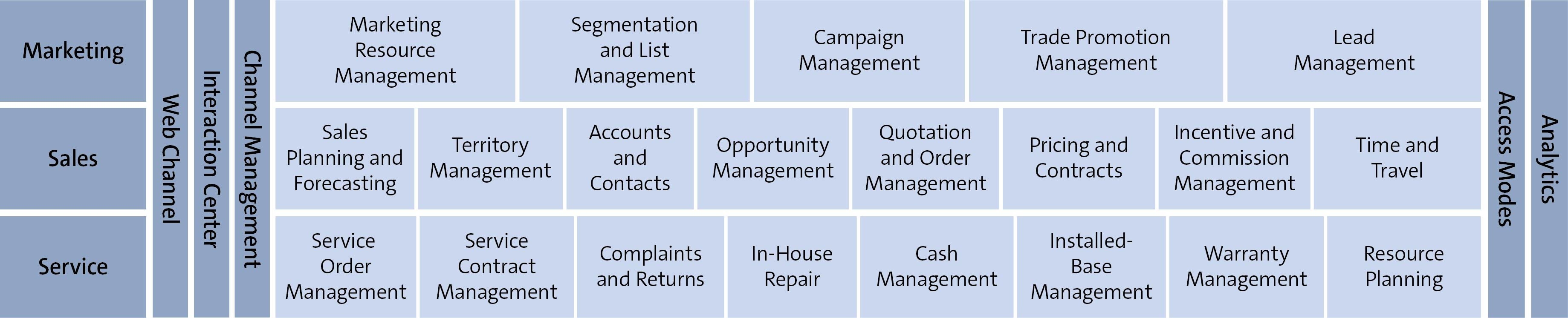
SAP Customer Relationship Management (SAP CRM) focuses on customer management. This includes areas such as marketing, sales, service, and e-commerce. By using SAP CRM, businesses can keep in touch with customers and learn how to best serve them.
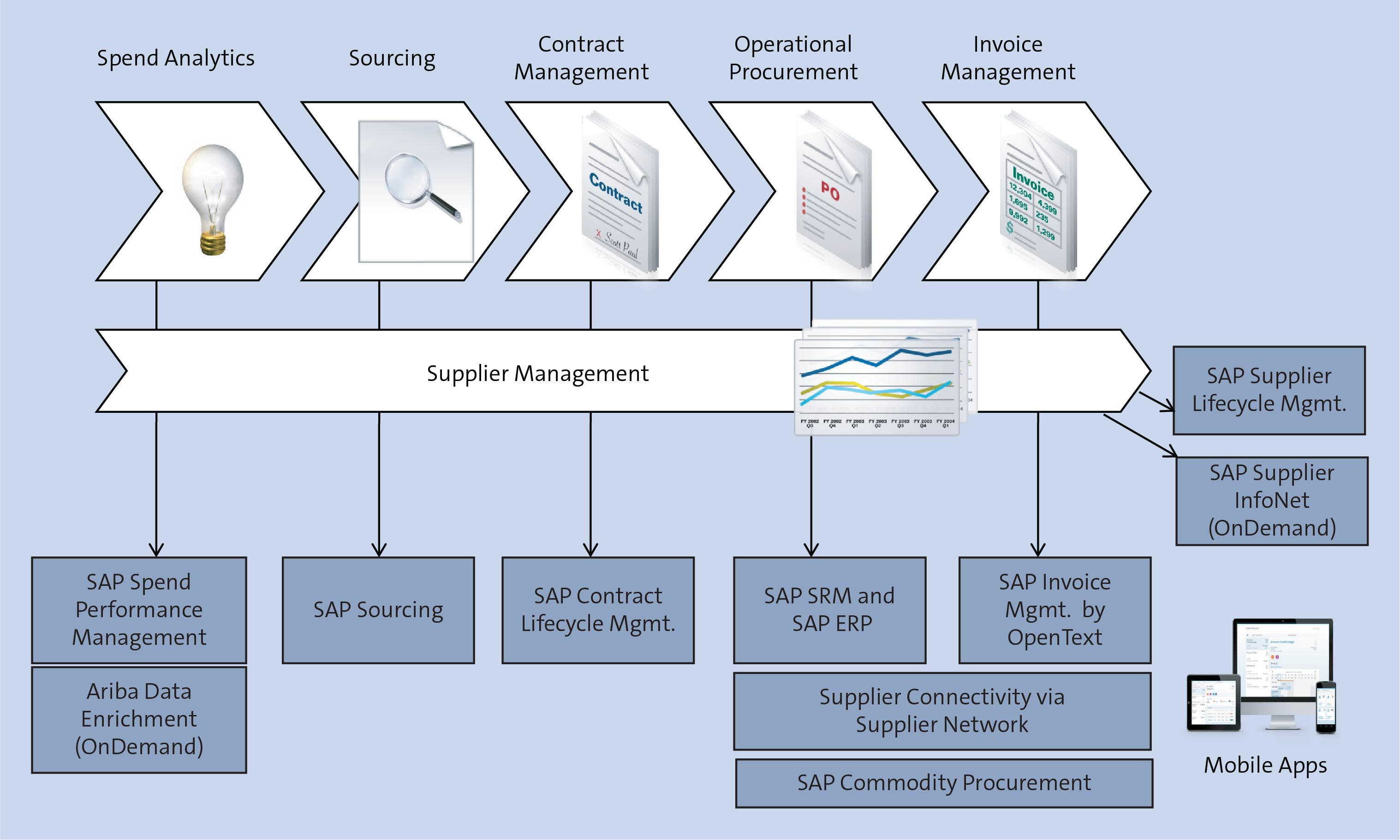
SAP Supplier Relationship Management (SAP SRM) focuses on the procurement process and the different stakeholders involved. This includes monitoring and measuring the efficiency of suppliers and vendors, tracking procurement activities, sourcing assignment of orders, managing contracts and invoices, and more.
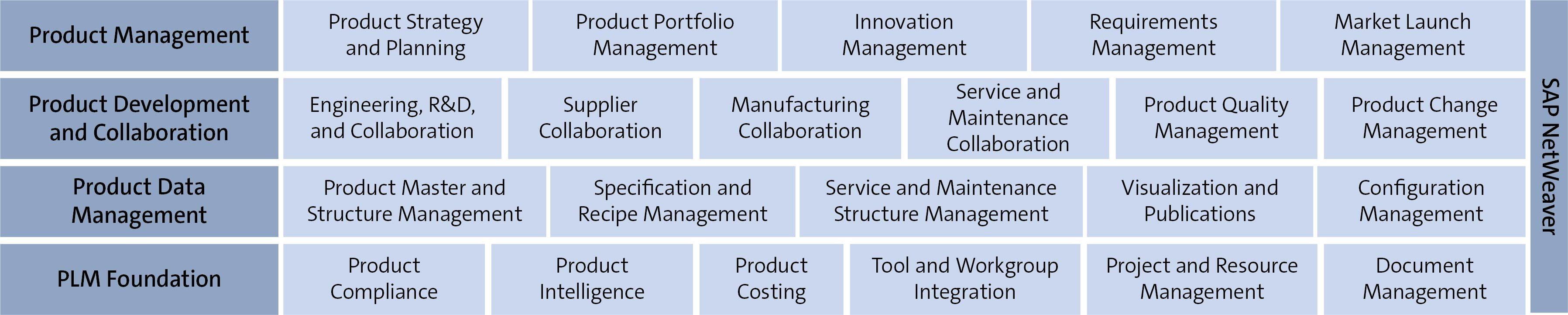
SAP Product Lifecycle Management (SAP PLM) focuses on the products a business offers from conceptualization to sunset. Operations such as portfolio planning, research and development, and manufacturing are considered tasks to complete with SAP PLM.
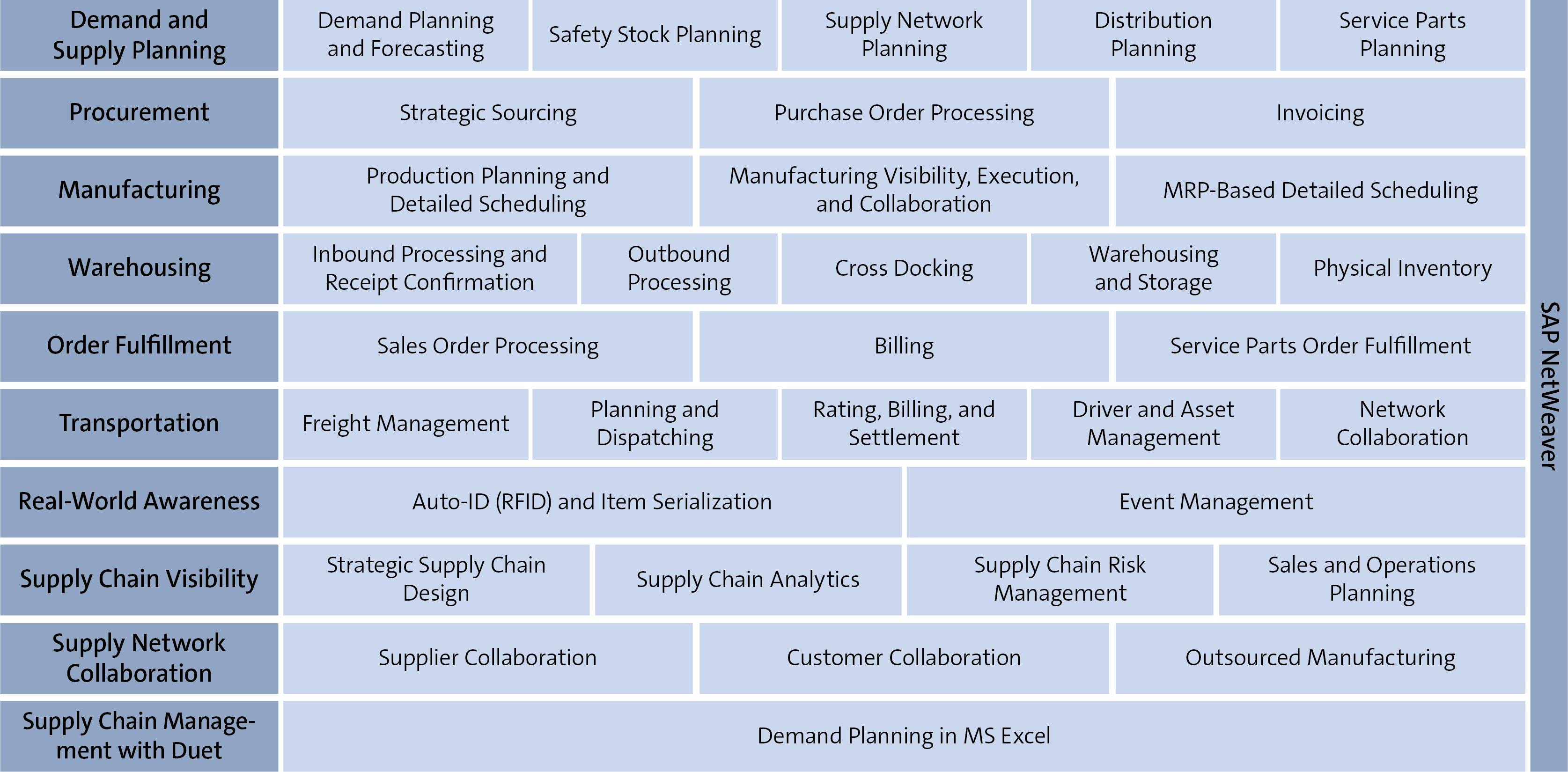
The SAP Supply Chain Management (SAP SCM) tools help businesses meet market demand. Activities include planning stock levels, manufacturing products from raw materials, fulfilling orders, transporting finished products, and collaborating with suppliers and other vendor partners.
SAP S/4HANA is SAP’s current flagship enterprise application suite. First released in 2015, the platform was the biggest change to SAP’s core offerings since the introduction of the R/3 system in 1992.
Among the key changes from SAP ERP were the utilization of SAP HANA’s in-memory computing architecture, the ability to gain real-time business statistics and analytics, and the convergence of transactional and analytical systems into one.
In addition to this, SAP used the product’s launch to reallocate some of the individual modules of SAP ERP into new lines of business (LoBs). SAP S/4HANA’s current LoBs are listed below.
The SAP S/4HANA Finance LoB focuses on all money-related activities of a business. This includes financial accounting, controlling, treasury and risk management, financial planning, financial close, and consolidation. SAP now incorporates AI capabilities into finance processes to help automate routine tasks, improve forecasting, and assist with financial analysis.
Learn more about SAP S/4HANA Finance here.
SAP breaks down logistics processes into four different LoBs rather than lumping them into the Supplier Relationship Management and Supply Chain Management categories as SAP ERP does. Across these logistics areas, AI helps organizations improve demand forecasting, inventory optimization, and supply chain planning.
Learn more about SAP S/4HANA’s logistics capabilities here.
The SAP S/4HANA Sourcing and Procurement LoB focuses on the activities surrounding the obtainment of raw materials needed to fulfill orders. This includes extended procurement, operational purchasing, and contract and supplier management.
The SAP S/4HANA Manufacturing LoB focuses on the product creation process. This includes responsive manufacturing, production operations, scheduling and delivery planning, and quality management.
The SAP S/4HANA Supply Chain LoB focuses on overall business planning activities, from pre-planning production runs to dispatching products to purchasers. This includes production planning, batch traceability, warehousing, and inventory and transportation management.
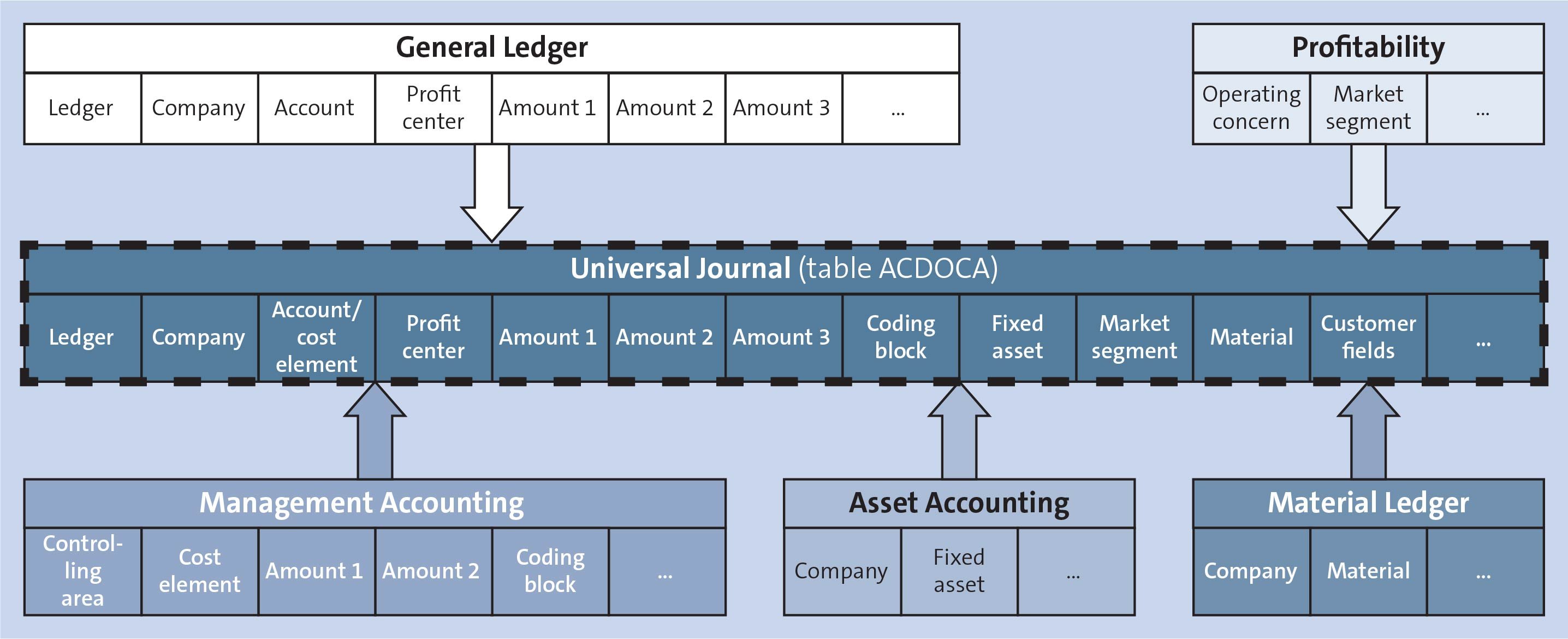
The SAP S/4HANA Asset Management LoB focuses on the maintenance of a business’ fixed assets, from smaller assets such as tools all the way up to buildings. This includes plant maintenance and EHS monitoring.
The SAP S/4HANA Sales LoB focuses on the activities associated with the buyers’ decision process. This includes pricing, sales inquiries and quotes, sales contracts and agreements, free-of-charge orders, available-to-promise checks, incompletion checks, repair orders, individual requirements, return authorizations, credit and debit memo requests, picking and packing, billing, and revenue recognition.
The SAP S/4HANA R&D LoB focuses on the lifecycle of a product. This includes defining the product structure and bill of materials, product lifecycle costing, managing portfolios and projects, managing innovation, managing chemical data and other sensitive materials used in development, and staying compliant with safety and health regulations.
The SAP S/4HANA Human Resources LoB covers on-premise HR processes including personnel administration and payroll. For cloud-based HR, SAP SuccessFactors remains SAP's primary offering and is the strategic direction for most new HR implementations. Embedded AI assists HR teams with recruiting, job description creation, skills matching, and workforce planning.
As organizations adopt SAP Cloud ERP, SAP offers two programs designed to support different implementation journeys.
RISE with SAP is intended primarily for existing SAP ERP customers that want to modernize their ERP landscape. It provides a guided transformation approach that combines proven methodologies, implementation tools, expert guidance, and cloud ERP to help organizations transition to SAP Business Suite and SAP Cloud ERP while following SAP's clean core principles.
In general, RISE with SAP focuses on helping existing SAP customers transform and modernize, while GROW with SAP is aimed at organizations beginning their journey with SAP Cloud ERP.
In summer 2018, SAP announced a suite of customer experience management solutions under the moniker SAP C/4HANA, and renamed it in 2020 to SAP Customer Experience. SAP Customer Experience consists of six core areas:
The SAP Customer Data Platform focuses on ethically collecting, keeping, and protecting customer information. It helps provide businesses with ways to initially and securely gather information filled in via form, and allows customers to control their data by being GDPR compliant. SAP Customer Identity and Access Management helps with customer authentication and onboarding.
SAP Emarsys Customer Engagement focuses on the tasks a business uses to earn and retain customers. This solution takes a look at data from all marketing activities and evaluates the impact of each. With this data, businesses can make informed decisions on how to speak to customers.
SAP Commerce Cloud focuses on product content management, experience management, personalization, and order management. This solution provides users with out-of-the-box functionality to create and maintain an e-commerce presence. SAP Recommerce focuses on the operations regarding preowned inventory.
SAP Sales Cloud focuses on serving the needs of a business’ sales team. The solution uses artificial intelligence to handle forecasting and other data collection and reporting, and provides employees with a 360-degree view of customers, ensuring nobody gets lost during the sales process.
The SAP Service Cloud focuses on handling numerous different requests for service from customers. Whether that means a late-night Facebook message or an in-person chat during call center hours, this solution helps teams provide a seamless and consistent experience for those customers asking for help.
SAP CX AI Toolkit focuses on automating repetitive tasks in the sales, service, and e-commerce areas. It also enables data analysis and recommendations via the Joule copilot. AI-powered recommendations, automated customer service, and sales insights help organizations deliver more personalized customer experiences.
Businesses are only as good as the conclusions they can draw from their data. For this purpose, SAP has created a suite of reporting and analytics tools to help make these decisions. These include SAP Analytics Cloud, SAP BusinessObjects, SAP BW/4HANA, and SAP Business Data Cloud.
With the advent of SAP S/4HANA, many reporting and analytics capabilities have been rolled directly into the LoBs, and SAP's intelligent technologies strategy is now centered on generative AI (delivered through Joule and SAP AI Foundation) alongside machine learning, IoT, and analytics capabilities embedded across the SAP portfolio. AI-powered analytics allow users to ask business questions using natural language and quickly uncover trends and insights from enterprise data.
SAP Business Technology Platform (SAP BTP) unifies data management, analytics, application development, integration, automation, and AI into a single cloud platform. It helps businesses turn data into actionable insight, modernize application landscapes, and embrace clean core strategies using extensible, modular services.
Learn more about SAP BTP in-depth here.
Clean core is SAP's recommended approach for keeping ERP systems easier to maintain and upgrade. Instead of modifying the core ERP application, organizations are encouraged to extend SAP solutions using SAP Business Technology Platform and modern development frameworks such as the ABAP RESTful application programming model (RAP).
By keeping the core system as close to standard SAP functionality as possible, organizations can adopt new innovations more quickly while reducing the complexity and cost of future upgrades.
SAP Business Data Cloud helps organizations bring together data from SAP applications and third-party systems into a unified, trusted foundation for analytics and AI. By connecting business data across the enterprise, it enables organizations to build dashboards, generate insights, and power AI applications using consistent, governed information.
SAP Business Data Cloud extends SAP's data and analytics capabilities by providing a unified, trusted foundation for SAP and third-party data. It works alongside SAP Business Technology Platform to support analytics, planning, and AI applications using governed business data.
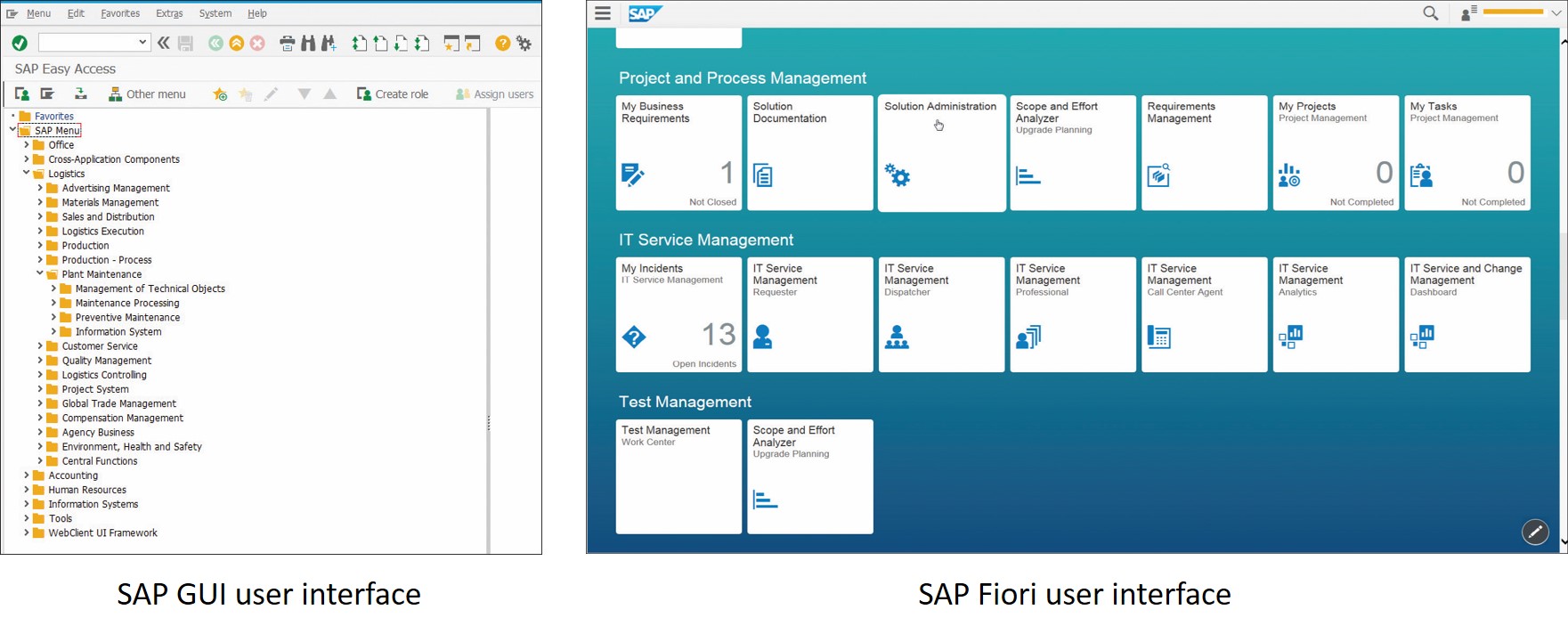
In addition to offering two major business suites, SAP also offers two main user interfaces: the SAP Graphical User Interface (GUI) for SAP ERP products and the SAP Fiori user interface for SAP S/4HANA and cloud products. Those using the GUI can also have it mimic the SAP Fiori interface for a more seamless experience when using both SAP ERP and SAP S/4HANA products.
SAP is constantly adding and improving functionality for its solutions, but there are a host of ways users themselves can add customizations to fit their unique needs and perform routine data management and administration tasks. Therefore it’s important to understand a little more about the technical aspects of SAP solutions.
SAP allows its customers to customize its solutions and offers a host of extensibility options for users to take advantage of. This extension can range from the simple modification of existing application code to the creation of brand-new applications that run directly on or alongside an SAP system.
Developers can choose, depending on the goal they’re looking to accomplish, from a host of coding languages when building applications with SAP. This includes Java, SQL and SQLScript, JavaScript, and HTML5 (SAPUI5). The most oft-used language, however, is the SAP-developed Advanced Business Application Programming (ABAP) language. Modern SAP development also emphasizes side-by-side extensions on SAP Business Technology Platform to support clean core principles.
ABAP is a multi-paradigm programming language, meaning programmers can utilize general principles such as procedural or object-oriented programming. Developers can also make use of two ABAP-specific programming models: the ABAP programming model for SAP Fiori and ABAP RESTful programming model.
SAP has a robust cloud portfolio of apps that allows users to work on the go. And what isn’t naturally (or “natively”) mobile can likely be made mobile with the help of a developer and the platform-as-a-service SAP Business Technology Platform (formerly SAP Cloud Platform). SAP also provides a handful of software development kits (SDKs) to help programmers extend SAP ERP and SAP S/4HANA.
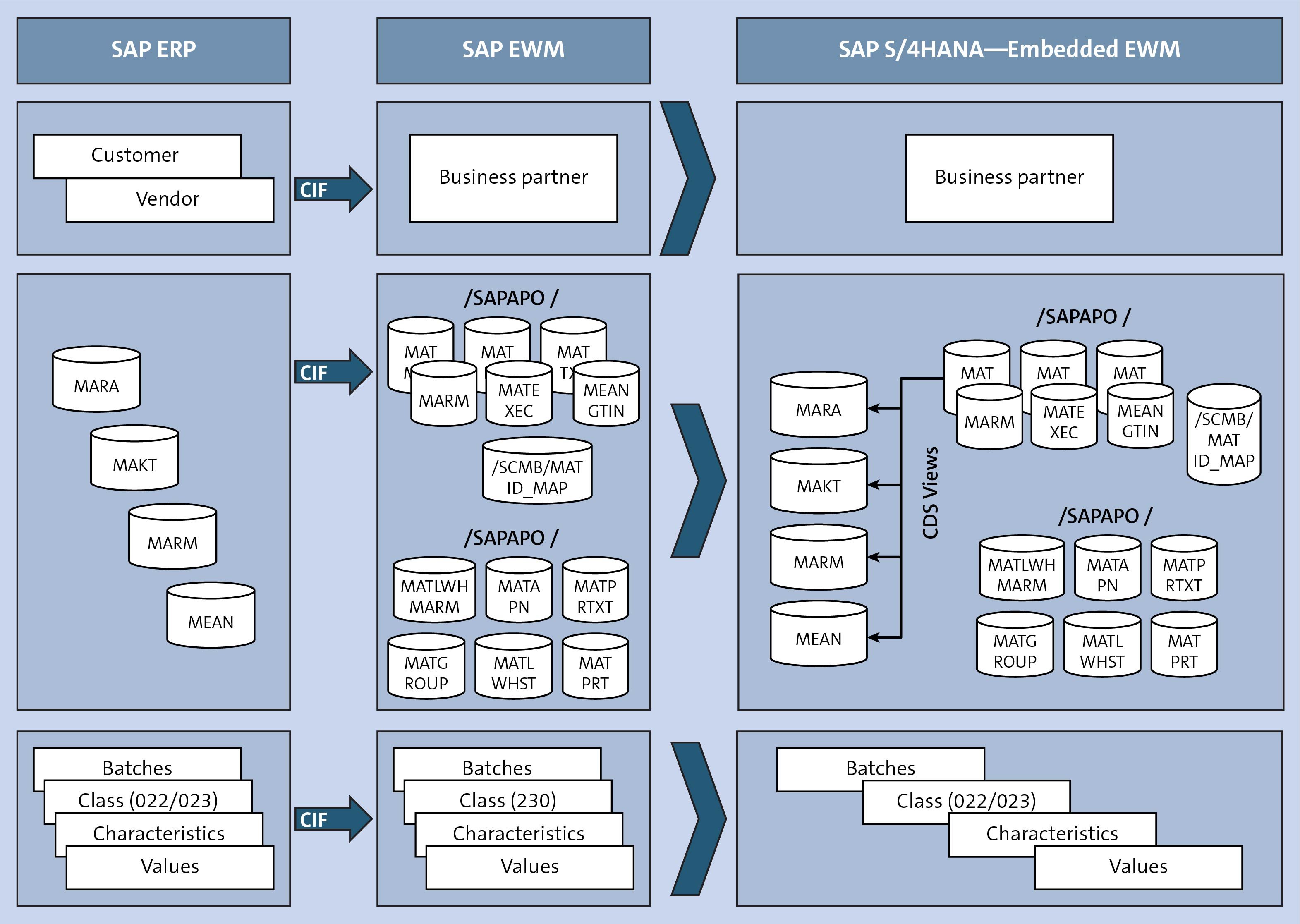
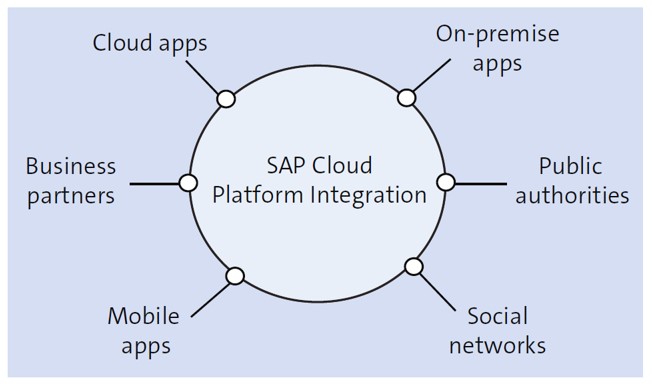
Quite often organizations utilize both SAP and non-SAP systems to do business. SAP offers a host of integration options with solutions such as SAP Integration Suite, SAP Process Orchestration, SAP Gateway, and SAP S/4HANA extensions such as adding custom fields or CDS views.
Additionally, SAP has created various tools for interfacing with non-SAP systems, such as Business Application Programming Interfaces (BAPIs), electronic data interchanges (EDIs), intermediate documents (IDocs), and application link enabling (ALE). SAP is also compatible with OData.
Those who have made the decision to utilize SAP find themselves with a host of administration options to utilize. SAP Solution Manager (known colloquially as "SolMan") has historically been used to maintain SAP landscapes, manage change control, and monitor system health.
SAP Cloud ALM is SAP's strategic successor to SAP Solution Manager for cloud and hybrid landscapes, and new implementations should consider SAP Cloud ALM as the primary application lifecycle management tool going forward. SAP Cloud ALM comes pre-loaded with guidance from SAP powered by content from the SAP Activate methodology, along with processes from the Enterprise Architecture Reference Library. The product helps you not only in implementations, but also in your operations and service deliveries.
A set of SAP HANA tools is also available for maintaining that database and platform. This includes options such as SAP HANA Cockpit, SAP HANA XS Administration Tools, and SAP HANA Lifecycle Manager. SAP HANA Studio has been deprecated as of SAP HANA 2.0.
Other tools that allow you to provision and clean data, manage information and databases, ensure security and data privacy compliance, and manage user access are available to SAP users.


SAP operates in multiple industries, each with its own lexicon. However, you’re likely to come across certain terms that span these industries during your time using SAP solutions. Let’s take a look at some of the most common.
Transaction code: An alphanumeric shortcut used for performing a specific task in SAP ERP. Also referred to as a t-code. Their SAP S/4HANA counterparts are SAP Fiori apps.
During the early twenty-first century when SAP was rapidly releasing and acquiring products, in addition to adding or changing available functionality it would occasionally rename them to better fit into its product portfolio. Below are two lists of old SAP product names that will help should you come across one.
Here are answers to some of the most common things business users want to know about SAP.
What does SAP stand for?
SAP stands for Systems, Applications, and Products in Data Processing.
What is SAP used for?
SAP provides enterprise software that helps organizations manage business processes across finance, HR, procurement, supply chain, manufacturing, and more. Its products are used by companies of all sizes across virtually every industry.
What is the difference between SAP ERP and SAP S/4HANA?
SAP ERP is SAP's legacy business suite, maintained through 2027 with extended support to 2030. SAP S/4HANA is SAP's current suite, built on the SAP HANA in-memory database, offering real-time processing, a simplified data model, and SAP Fiori-based user experiences. SAP S/4HANA is SAP's strategic direction for all new ERP implementations.
What is SAP BTP?
SAP Business Technology Platform (SAP BTP) is SAP's cloud platform for application development, integration, data management, and AI. It serves as the extensibility and integration layer across the SAP portfolio and is the foundation for SAP AI Foundation and Joule.
How many customers does SAP have?
SAP has more than 400,000 customers worldwide across industries including manufacturing, retail, financial services, healthcare, and the public sector.
What is Joule?
Joule is SAP's generative AI copilot, embedded across the SAP portfolio including SAP S/4HANA, SAP SuccessFactors, SAP Ariba, and SAP BTP. It allows users to interact with SAP systems using natural language and is expanding into agentic AI capabilities that can autonomously execute multi-step business processes.
What is SAP Business Data Cloud?
SAP Business Data Cloud is SAP's unified data foundation for analytics and AI. It connects SAP and third-party data so organizations can create trusted reports, dashboards, planning models, and AI-powered applications using consistent business information.
Is SAP difficult to learn?
SAP has a reputation for being complex because it supports many different business processes and industries. However, beginners can learn SAP successfully by focusing on one area at a time, such as finance, supply chain, human resources, analytics, or development. Many professionals start with the business processes used in their role before learning the SAP applications that support them.
Which SAP solution should I learn first?
The best place to start depends on your career goals.
Finance professionals often begin with SAP S/4HANA Finance.
Supply chain professionals may start with materials management (MM), sales and distribution (SD), or extended warehouse management (EWM).
HR professionals typically begin with SAP SuccessFactors.
Developers often learn ABAP and SAP Business Technology Platform.
Business analysts frequently start with SAP Analytics Cloud.
Choosing a learning path that aligns with your current job or desired career is usually more effective than trying to learn every SAP product.
Is SAP still in demand?
Yes. SAP continues to be one of the world's leading enterprise software providers, and organizations across industries rely on SAP solutions to manage finance, supply chain, procurement, manufacturing, human resources, customer experience, and analytics. As companies continue migrating to SAP S/4HANA and expanding their use of cloud technologies and AI, demand remains strong for professionals with SAP skills.
Can I learn SAP for free?
There are many free resources available for learning SAP concepts, including tutorials, documentation, videos, and community content. However, comprehensive books, structured online courses, and hands-on practice systems often provide a more complete learning experience and help learners build practical skills more quickly.
How long does it take to learn SAP?
The time required depends on your goals and prior experience. Learning the fundamentals of SAP and a single functional area can take a few weeks to a few months of focused study. Becoming proficient enough to implement, administer, or develop SAP solutions typically requires hands-on experience over a longer period.
Learn more SAP from our official Learning Center.
And to continue learning even more about SAP, sign up for our weekly blog recap here: